

The Captain Answers is a regular column for Keppel members to ask questions relating to golf at Keppel Club. If you have any questions or suggestions for the Captain, email to: thecaptainanswers@keppelclub.com.sg.
Publication of the questions received is at the discretion of the Newsletter Sub-Committee.
Hollow Coring: An essential practice for healthy golf courses
By Captain Anthony Maniam
If you have played over the last month or so on our beloved Sime course, you would have noticed that some of our greens have holes in them. In the maintenance of a golf course, this is known as hollow coring, or also known as aeration and is a critical maintenance practice for golf course greens. This process involves removing small cores or plugs of soil from the green, creating holes that help alleviate compaction, improve soil structure, and enhance the overall health of the turf. Here is an in-depth look at why hollow coring is essential and how it benefits golf courses.
Why is Hollow Coring necessary
- Alleviates soil compaction: The greens on a golf course experience significant foot traffic from golfers and maintenance equipment. Over time, the constant pressure compacts the soil and reduces its porosity, making it harder for roots to grow. Compacted soil can lead to poor drainage, reduced air exchange, and a weakened turf.
- Improves water infiltration and drainage: Compacted soil impedes water infiltration, leading to surface runoff and waterlogging which can damage the turf. Hollow coring creates channels that allow water to penetrate deeper into the soil, improving drainage and reducing the risk of disease caused by excess moisture.
- Enhances air exchange: Grass roots need oxygen to thrive. Compacted soil limits the amount of air that reach the roots. The holes created by hollow coring facilitate better air exchange, promoting healthier root systems and more robust turf growth.
- Promotes thatch decomposition: Thatch which is a layer of dead grass and organic matter that accumulates on the soil surface can hinder water and nutrient movement to the roots. Hollow coring helps break up thatch, allowing for better integration of organic matter into the soil and encouraging microbial activity that decomposes the thatch.
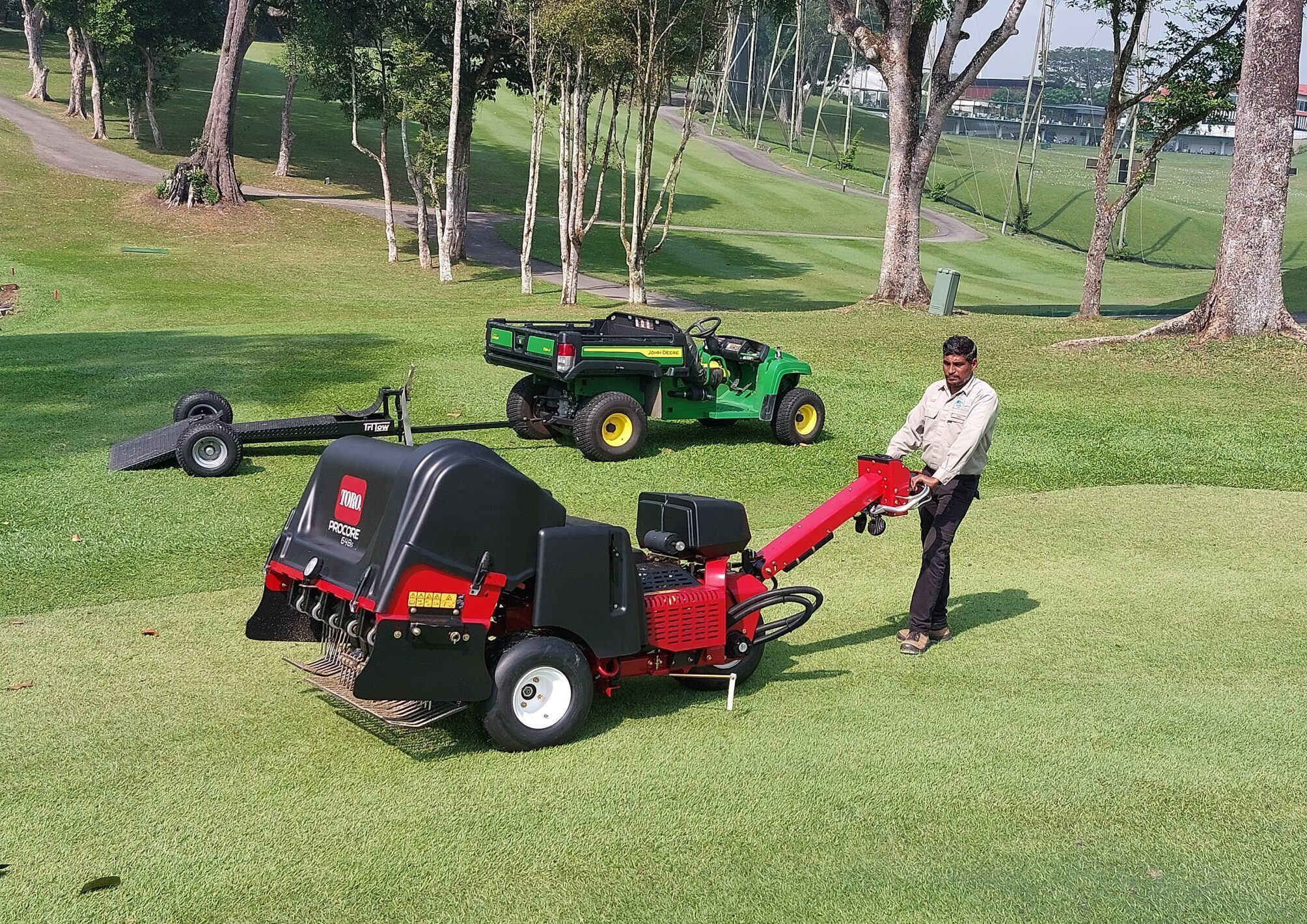
The Hollow Coring Process
- Coring equipment: Specialised aerators equipped with hollow tines are used for this process. These machines penetrate the soil to a specific depth and extract small cores of soil and thatch, which are then deposited on the surface of the green.
- Core removal and cleanup: After coring, the plugs of soil and thatch are left on the surface. These cores can be collected and removed, or they can be broken up and redistributed over the green to help topdress the surface.
- Topdressing and sanding: Following core removal, the greens are often topdressed with a layer of sand. This sand helps fill the holes, smooth the surface, and improve the soil structure. Sand topdressing also aids in further breaking down any remaining thatch.
- Recovery and maintenance: The holes created by hollow coring may initially disrupt the smoothness of the green, but with proper watering, fertilisation, and mowing, the turf recovers quickly. The benefits of improved root growth, better water infiltration, and enhanced air exchange far outweigh the temporary disruption.
Benefits of Hollow Coring
- Healthier turf: The improved soil conditions foster healthier, more resilient turf that can better withstand foot traffic, environmental stresses, and disease.
- Enhanced playability: While hollow coring temporarily affects the smoothness of the greens, the long-term benefits include more consistent and higher-quality putting surfaces.
- Sustainable course management: Regular hollow coring is part of a sustainable approach to golf course maintenance, ensuring the greens remain in top condition all year round.
Hollow coring is a vital maintenance practice for golf course greens, essential for maintaining healthy, resilient turf. By alleviating soil compaction, improving water infiltration, enhancing air exchange, and promoting thatch decomposition, hollow coring helps ensure the greens remain in pristine condition. Though it may cause temporary disruption, the long-term benefits for the playability and health of the course make it an indispensable part of golf course management. So, the next time you see a green being aerated, know that It is a crucial step in keeping the course in peak condition for all golfers to enjoy. Look forward to healthier, firmer and faster greens!